Powered By Blogger

Friday, September 26, 2014

Pluto

Hi guys. Today we will be talking about Pluto. I've always wondered why Pluto was called a dwarf planet, but in this post, we will find out. To start, Pluto is about 3.67 billion miles away from the sun. Pluto follows an elliptical orbit around the sun and like I told you in the post Neptune, Pluto follows an orbit that crosses Neptune's orbit, so keep in mind that this distance is the average distance. Pluto has a twin moon called Charon. These 2 moons are always facing the same side, so if you were on Pluto, you would only see the front side of Charon and not the back side, no matter where ever you are in the orbit. Pluto was known as a planet, until 2006, when the astronomers decided that Pluto didn't have the traits that a planet should have. Now Pluto is known as a dwarf planet. Pluto is a rocky planet containing rock and ice. Pluto's position is in between Neptune and Eris as you can see from this map.


(This map does not have all the dwarf planets, but it has some.)

So, now you know that Pluto got demoted to a dwarf because he didn't do well in school. Try your best in school and get good grades, or else you might get demoted as well!! Happy new school year!!(For the people who still go to school!!)

Visit www.anishspace.blogspot.com for more!!! Also try to give me feedback on concerns in the comments section. Thanks for coming!

Thursday, July 24, 2014

Dwarf Planets

Hi guys. You better get prepared because we are going to shrink down smaller than the dwarf planets today. Today we are going to be talk about dwarf planets. Dwarf planets are basically space figures that are too small to be planets. Take Pluto for instance. Pluto was a planet until 2006, when some scientists decided that Pluto should not be a planet because it is too small to be one. There are 5 dwarf planets in the solar system. The first one is Ceres. The 2nd, Pluto. The 3rd, 4th, and 5th dwarf planets are Haumea, Makemake, and Eris. You may think that the solar system only consists of the sun, 8 planets, and moons. Actually, that is wrong. There is an asteroid belt, comets, meteors, dwarf planets and more. Here is a picture of all the dwarf planets.


Stay tuned to www.anishspace.blogspot.com for more.

Friday, July 4, 2014

Neptune

BLUE, BLUE, BLUE. That is what you would say when you look at Neptune. See for yourself:


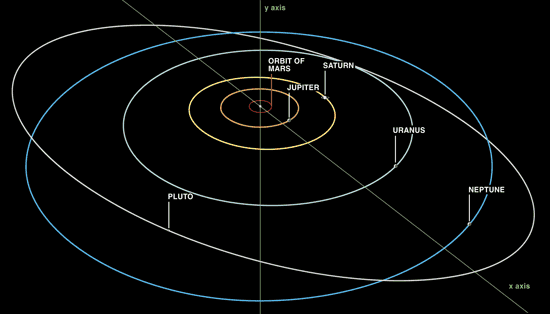
This planet is so blue that if your favorite color is blue, you might be overwhelmed with blue and choose a different color instead. Anyways, today, I will be talking to you about Neptune, the last but not least planet of the solar system. Neptune is one of the gas giants and it is about 2.77 billion miles away from the Sun!! Also did you know that sometimes, Pluto gets closer to the Sun in its orbit so it passes Neptune for a short while? Here is a picture of Pluto in front of Neptune:


As you can see, Pluto's orbit intersects with Neptune's orbit and goes in front of it. Neptune also has a lot of moons. It's most famous moon is Triton for it's size. It is also the biggest moon Neptune has. If you weigh 70 pounds on Earth, you would weigh 75.8 lbs on Neptune. Neptune is composed mainly of hydrogen, helium and methane.


If you love the color blue, then the next destination for you is Neptune, because, well, you know why.

I'd like to say thank you for visiting my blog so far and look forward to the posts that are coming up. I also would like to say thanks to the people who were with me the whole way so far. Our unit on the Solar System Planets is done and you should be proud of what you have learned in the past two months. Next week, Intro to Dwarf Planets. I look forward to keep on blogging and once again, I'd like to say thank you and I wish you a happy 4th of July.

-Anish Sikhinam

Tuesday, July 1, 2014

Uranus

Ah, Uranus. Probably the most weird planet everyone has seen. Do you know why it's weird? It's tipped over!! Uranus is  a bluish-green planet that was once hit. The impact of that hit tipped the whole planet over!
The planet Uranus is the seventh planet from the Sun and is the second to last planet (not including dwarf planets) in the solar system. I always think of Uranus as "my favorite colored planet" because the color is my favorite color. Uranus is made mostly of a chemical called methane. Methane is what gives the planet its color. Here is a diagram that shows what Uranus is made of:

I explained to you that most of the time, the bigger the planet, the bigger the amount of mass. The bigger the amount of mass, the more gravity there is. BUT, Uranus's gravity is not as strong as Earth's. This is because Uranus doesn't have a lot of mass. In other words, Uranus isn't very dense. So, if you weigh 70 pounds on Earth, you would weigh 62 pounds on Uranus. Did you know that ALL the gas planets have rings? All the gas planets, except Saturn, have very small rings and very few rings. Since Uranus is a tipped planet, the rings are also tipped. The rings are, instead of going sideways, they are going up and down. Here is another cool fact: Uranus also rotates in a weird way, not like the other planets. Instead of spinning right and left, sort of like those rotors on the fan, it rolls up and down like a bowling ball. Here is a picture of the rotation of Uranus compared to the rotation of normal planets:


Even though Uranus is a bit weird, it is important to have in our solar system.
Uranus, the weird planet.


Uranus with rings.


Stay tuned for Neptune, the planet of blue, coming out on Saturday, June 5, 2014 on www.anishspace.blogspot.com.